
Addition Game
A focused addition game where players match small sums and collect stars.
Tested by NumBlocksGen
What we reproduced
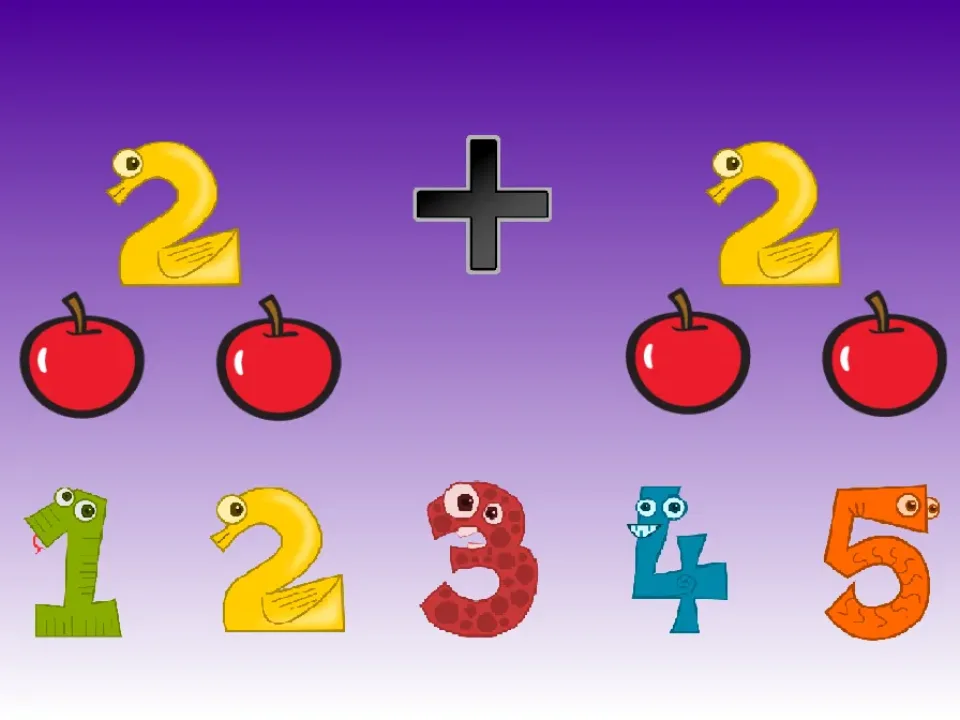
- The captured round displayed two groups representing 2 + 2.
- Five large answer choices from 1 through 5 stayed visible along the bottom of the board.
- The board used both number characters and apple groups, providing two visual ways to read the same small sum.
Known limitation: The activity stays within a small answer range and is better for quick recognition practice than broad arithmetic instruction.
Scratch project by teromakotero. View the original Scratch project Packaged with TurboWarp Packager and credited to the original Scratch creator.
Original project title: Addition Game by teromakotero on Scratch. Credit reference NBG-RIGHTS-003 is recorded as owner confirmed and was reviewed 2026-07-17.
The source instructions say the game shows two numbers or apple groups, the player chooses the matching sum from buttons 1-5, earns a star per correct answer, and wins after five stars. The stated number range is 1 to 5.
Editor's Guide
Our test captured a 2+2 round: two groups of two apples were shown, with answer buttons 1 through 5 at the bottom. The dual representation (numerals plus apple groups) helps connect symbols to countable objects.
This game practices recognizing small sums (1-5 range per source). It assumes children can count to 5 but may not have memorized addition facts yet.
Based on our observation, this suits early learners building confidence with small addition. Students who already know sums to 10 will find it too simple.
- Ages 5-7 learning addition for the first time (our suggestion)
- Connecting counting to addition facts
- Building confidence with sums in the 1-5 range
- Short practice sessions (5 minutes or less)
- Visual learners who need to see quantities represented
This game helps transition from counting concrete objects to understanding addition relationships. The visual representation provides a mental image to recall when solving similar problems later. The narrow range builds confidence before tackling larger sums.
- The 1-5 range (per source) is intentionally limited. Students ready for sums to 10 or 20 need different practice.
- Children who can already add to 10 will find this unchallenging; use for review or confidence only.
- Fixed buttons mean students could guess without understanding. Watch for random clicking.
- No error feedback beyond not earning a star. Some learners need explicit correction.
- We tested one round (2+2). Other combinations might display differently.
- Very young children may struggle with mouse/touch precision; practice clicking before focusing on math.
Why this game is worth playing
- Our test confirmed both apple groups and numerals appear, supporting multiple learning styles
- The five-star goal (per source) is concrete and achievable in a short session
- Fixed answer choices (1-5) reduce anxiety compared to open-ended questions
- Answer buttons connect a counted total to clicking the numeral
- No time pressure: students can count carefully before answering
How to play
- Click the green flag in the game frame.
- Look at the two numbers or apple groups.
- Choose the number that matches the sum.
- Collect five stars to win.
Tips before you play
- Before clicking, ask: "How many in first group? How many in second? What is the total?"
- Encourage pointing to each apple while counting, making the one-to-one correspondence visible.
- After a correct answer, ask: "Will 2+2 always equal 4, or does it change?" to build constancy understanding.
- If child rushes or guesses, pause and count together on paper or with real objects.
- Celebrate when counting is no longer needed - instant recognition of 2+2=4 is the goal.
- After mastering 1-5 sums, move to problems with larger numbers rather than repeating this game endlessly.
- Use wrong answers to diagnose: Did they miscount? Add incorrectly? Guess? Each needs different support.
- Pair with offline practice: counting snacks, stacking blocks, or drawing addition pictures.
Addition Game FAQ
What is the number range in Addition Game?
The Scratch instructions say the number range is from one to five.
How do players win a round?
The source instructions say the correct answer gives a star, and five stars win the game.
What should a player look at before choosing an answer?
The original instructions say the game shows two numbers or matching quantities of apples, so players should count or read both parts before pressing the sum.