
Alphabet Game
Drag letters into numbered positions and practice alphabetical order in a focused sequence game.
Tested by NumBlocksGen
What we reproduced
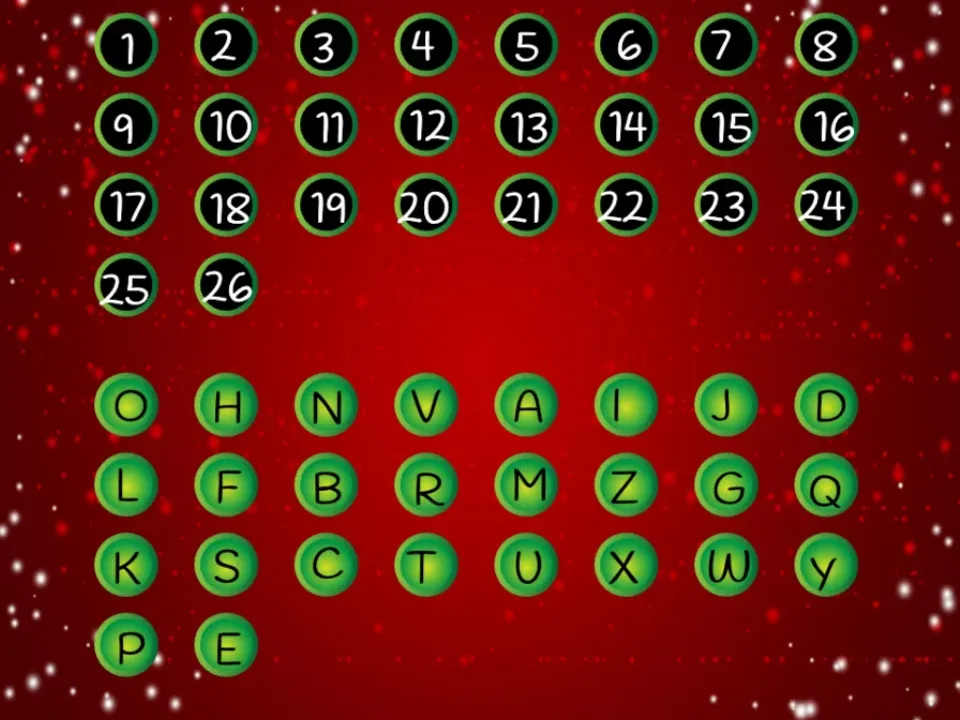
- The board displayed 26 numbered target positions across the upper half of the screen.
- All letter tiles appeared in a shuffled arrangement below the targets.
- The main interaction was direct dragging, with no additional menus interrupting the ordering task.
Known limitation: The dense board and drag targets require more pointer precision on small screens.
Scratch project by teromakotero. View the original Scratch project Packaged with TurboWarp Packager and credited to the original Scratch creator.
Original project title: Alphabet Game by teromakotero on Scratch. Credit reference NBG-RIGHTS-012 is recorded as owner confirmed and was reviewed 2026-07-17.
Source instructions say to click the green flag, then use the mouse to drag letters into correct alphabetical order on top of numbered positions 1-26. This practices letter sequencing.
Editor's Guide
Our test captured the complete board: 26 numbered target positions across the top and all letter tiles shuffled below.
The task (per source and our observation) is drag each letter to its correct position in alphabetical order.
This combines letter sequence knowledge with drag control and working memory (remembering where letters belong while manipulating them).
- Ages 5-7 learning alphabetical order beyond song recitation (our suggestion)
- Classrooms teaching library and dictionary skills
- Fine motor practice with academic content
- Students who know letter names but struggle with their sequence
- Quick independent activity during centers (5-10 minutes)
This game builds flexible alphabet knowledge: locating a letter's position without reciting from A each time. Develops sequential thinking (order matters and is consistent) and fine motor control (precise dragging). Skills combine in real tasks like alphabetizing books or using indexes.
- The full 26-letter board (per our capture) is dense. Small screens make dragging harder.
- Mouse/touchpad dragging is more precise than some touch screens. Test input method first.
- No partial save. If student quits mid-game, progress is lost.
- The game does not teach letter names or sounds. Assumes that knowledge exists.
- Younger students (preschool/early K, our suggestion) may find 26 tiles overwhelming.
- Students who have only memorized alphabet song may struggle with non-linear access.
- No hint or feedback system. Students must self-assess or rely on teacher/peer checking.
Why this game is worth playing
- Our test confirmed all 26 positions and letters are visible simultaneously, reducing memory load
- Numbered positions (visible in our capture) provide scaffolding for verification
- Drag interaction (from observation) combines motor skill with academic content
- Task completion is concrete: when all positions filled, you are done
- Can be done collaboratively (two students) or independently
How to play
- Click the green flag in the game frame.
- Drag each letter with the mouse.
- Place the letters on the matching number order.
- Keep arranging until the alphabet is complete.
Tips before you play
- Start by placing a few confident "anchor" letters: A, M, Z. These provide reference points.
- Say the alphabet aloud while dragging to engage verbal memory: "A, B, C, D... E is 5th, position 5."
- If uncertain where a letter belongs, count from A or backward from Z, whichever is shorter.
- After placing several letters, read the sequence aloud to check for errors before continuing.
- For struggling students, reduce the task: "Let's do A through J first, then K through T."
- Use numbered positions actively: "L is the 12th letter. Count to position 12."
- If child drags randomly, pause and recite alphabet together first.
- Celebrate partial success: "A through G are perfect! Now let's work on H through N."
Alphabet Game FAQ
How do I start Alphabet Game?
The Scratch instructions say to start by clicking the green flag.
What is the main action?
The source instructions say to use the mouse to drag letters into the right order on top of the numbers.
What skill does this page focus on?
The source task is ordering letters, so this page is best treated as alphabet sequence practice.