
Hop & Drop
Drag pins, hop over pieces, and finish each level with one pin left in this compact logic challenge.
Tested by NumBlocksGen
What we reproduced
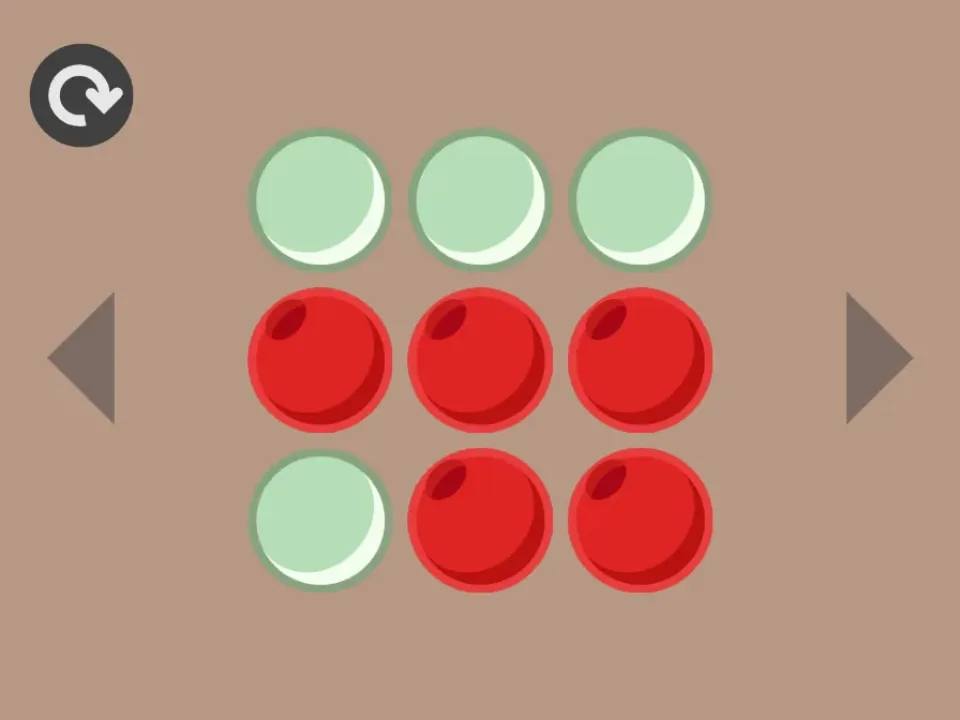
- The captured board used a three-by-three peg layout with red pins and open spaces.
- A restart control remained visible in the upper-left corner.
- Left and right arrows changed the selected puzzle layout without leaving the game board.
Known limitation: The board relies on precise drag gestures and provides little text guidance once play begins.
Scratch project by qucchia. View the original Scratch project Packaged with TurboWarp Packager and credited to the original Scratch creator.
Original project title: Hop & Drop by qucchia on Scratch. Credit reference NBG-RIGHTS-008 is recorded as owner confirmed and was reviewed 2026-07-17.
Source description says to drag a pin to hop over another pin (removing it), drop into empty space, and finish with one pin left to beat a level. Project notes mention uncertainty about level 11 behavior.
Editor's Guide
Our test captured a playable board with red pins, open spaces, level arrows, and a visible restart control in the top-left corner.
This is peg solitaire: every move removes one pin, so a board with N pins takes N-1 moves, leaving one final pin. Poor early choices can create unsolvable configurations.
Success requires working backward from the goal state: where do you want the final pin? What configuration enables that? Then what enables that configuration?
- Students learning consequence tracking and logic (our suggestion for grades 4-8)
- Players who enjoy classic logic puzzles like Sudoku
- Short puzzle sessions during breaks or transitions
- Developing planning skills and impulse control
- Anyone who finds fast action games stressful (this is calm and thoughtful)
This game teaches retrograde analysis: reasoning backward from desired outcomes to determine necessary prior states. This skill is essential in mathematics (proof construction), programming (algorithm design), and strategic games (chess, Go).
- Level 11 is flagged as unusual per source notes. Expect potential oddities there.
- Drag precision matters. On small screens or with limited motor control, this can be challenging.
- No tutorial beyond basic mechanic. Strategic thinking must be self-discovered or taught.
- Younger children (under 7, our suggestion) may lack working memory capacity for multi-move planning.
- The game does not explain why a move was bad, only that the result is unsolvable.
- Some students will trial-and-error rather than plan. This works short-term but blocks deeper learning.
Why this game is worth playing
- Our test confirmed the intuitive drag-based controls: hop over, land in empty space
- Small boards make all information visible at once; no hidden state
- The one-pin-remaining goal (per source) is perfectly clear
- Level arrows (visible in our capture) let you skip frustrating boards and return later
- Restart control (captured in test) is instant and penalty-free, encouraging experimentation
How to play
- Click the green flag in the game frame.
- Drag one pin over another pin to hop.
- Drop the pin into an empty space after the hop.
- Clear the board until only one pin remains.
Tips before you play
- Start by identifying isolated pins that cannot hop or be hopped over. These often reveal dead ends.
- Work backward: choose your desired final pin position, then ask what previous configuration allows it.
- First moves matter enormously. The opening hop constrains all future moves; avoid random starts.
- If stuck after several moves, restart. Continuing from an unsolvable position wastes time.
- Watch for pin pairs with one space between them; these can hop back and forth for setups.
- Do not leave single pins in corners unless that is your target final position.
- For teaching: have students state strategy before hopping: "I will clear center first, then work outward."
- Level 11 is flagged as unusual in source notes. Approach it with flexibility if you reach it.
Hop & Drop FAQ
How do I move a pin?
The project description says to drag a pin to hop over another pin and drop it to move.
How do I beat a level?
The source description says a level is beaten by finishing with only one pin left.
Is level 11 unusual?
The Scratch instructions mention uncertainty about what is supposed to happen in level 11, so that level may feel different from the others.